
Industrial Safety Barrier Systems


Pedestrian Safety Barriers
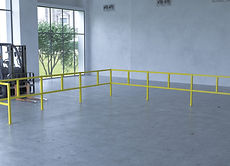
A light duty system providing a simple and economical way to create safe pedestrian areas at ground or raised floor level, in factory or warehouse.
The recommended maximum height of rails is 1,100 mm, the recommended maximum length of rail between each post is 2,000 mm.
Height and length of rail are manufactured to suit customers’ requirements.
Single or double rails are bolted to posts, allowing individual components to be replaced easily.
SPECIFICATIONS:
-
Rail - Hollow section 50 x 50 x 2.5 mm
-
Posts - Hollow section 50 x 50 x 2.5 mm. Post tops fitted with black plastic inserts
-
Base Plates - 150 x 50 x 10 mm
-
Finish - Powder-coated Yellow RAL 1018 or to customers’ requirements
Handrail Infill
A low cost solution to provide additional protection to handrail around mezzanine floors.
SPECIFICATIONS:
-
Standard Height - 1,788 mm
-
Standard Width - 1,448 mm
-
Mesh - 2” x 2”
-
Angle Frame - 50mm x 50mm (Sides) 43mm x 43mm (Top and Bottom)

Crash Barriers
Our crash barriers consist of steel rails bolted to support posts, mounted on base plates, and are designed to protect machinery, racking, shelving and partitioning from damage.
SPECIFICATIONS:
-
Heavy Duty Steel Rail (galvanised) - 312 mm deep / 3.2 m lengths / Twin rail version available
-
Support Post - 100 x 100 x 3.5 mm
-
Height - 750 mm (Special heights can be supplied)
-
Base Plate - 200 x 200 x 10 mm
-
Finish - To customers’ requirements

Tubular Barriers
Tubular barriers are low level and heavy duty with rounded corners for protection of people and equipment.
SPECIFICATIONS:
-
Height - 500mm or 750mm
-
Individual barrier length - up to 2,500mm
-
Maximum length with centre post - 4,000mm
-
Finish - To customers’ requirements

Benefits of Industrial Safety Barrier Products
Industrial safety barriers are essential for protecting people, equipment, and infrastructure in busy industrial environments. Key benefits include: Enhanced Workplace Safety – Creates clear separation between pedestrians, vehicles, and hazardous areas. Asset Protection – Shields machinery, racking, and building structures from accidental impacts. Reduced Damage Costs – Minimises repair and maintenance costs caused by forklift or vehicle collisions. Improved Traffic Management – Organises vehicle and pedestrian routes for safer, more efficient movement. Regulatory Compliance – Supports adherence to workplace health and safety standards. Increased Efficiency – Reduces disruptions and helps maintain smooth operational flow. Long-Term Cost Savings – Lowers accident-related costs, downtime, and insurance claims. Versatile Applications – Suitable for warehouses, loading bays, machinery protection, and walkways. Typical Applications: Industrial safety barriers are widely used in: Warehouses and distribution centres Manufacturing plants Logistics and transport hubs Loading bays and docks Pedestrian walkways Machinery protection zones Storage racking areas Building and infrastructure protection Process: Site Survey – Assess risks, traffic flow, and operational requirements. Design – Develop a tailored safety barrier layout for your facility. Manufacture – Produce durable barrier systems to required specifications. Installation – Professional fitting with minimal disruption to operations. Completion – Fully protected, safer working environment ready for use. FAQs: What are industrial safety barriers? They are protective systems designed to separate pedestrians, vehicles, and hazardous areas to reduce accidents and improve workplace safety. Where are safety barriers used? They are commonly used in warehouses, factories, logistics centres, loading docks, and other high-traffic industrial environments. Do safety barriers protect equipment as well as people? Yes. They help prevent damage to machinery, racking, walls, and other valuable infrastructure caused by vehicle impacts. Are safety barriers required for compliance? In many cases, they support compliance with health and safety regulations by reducing workplace risks and improving site organisation. Are industrial safety barriers cost-effective? Yes. While they require initial investment, they significantly reduce long-term costs related to accidents, repairs, downtime, and insurance claims.